
AI slop is ruining everything.
And we are being programmed to talk like them.

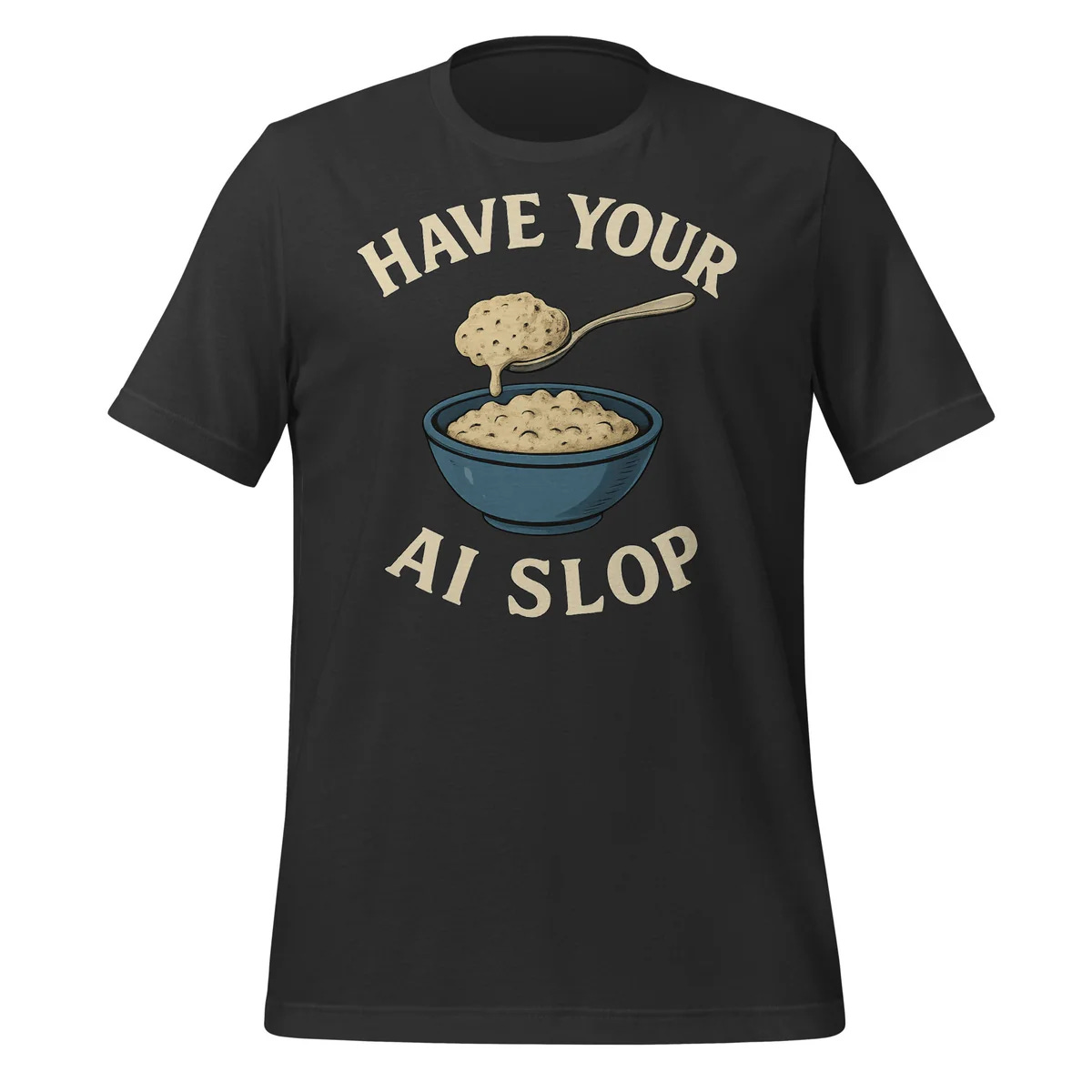
As AI generated slop seeps into everywhere — like social networks, Reddit, and faux articles in national publications — people are adopting the mannerisms of chatbot style. Not surprising, since chatbots developed their ‘voice’ by reading everything scrape-able online, and now what it’s reading is second-generation AI slop.
Kat Tenbarge wrote about the slop infection on Reddit:
Vibe Shift for the Worse
Ally, a 26-year-old who tutors at a community college in Florida and spoke using her first name only for her privacy, has noticed Reddit “really going downhill” in the past year because of AI. Her feelings are shared by other users in subreddits like r/EntitledPeople, r/simpleliving, and r/self, where posts in the last year have bemoaned the rise of suspected AI. The mere possibility that something could be AI-generated has already eroded trust between users. “AI is turning Reddit into a heap of garbage,” one account wrote in r/AmITheJerk. “Even if a post suspected of being AI isn’t, just the existence of AI is like having a spy in the room. Suspicion itself is an enemy.” Ally used to enjoy reading subreddits like r/AmIOverreacting. But now she doesn’t know if her interactions are real anymore, and she’s spending less time on the platform than in years past.
“AI burns everybody out,” says the r/AITAH moderator. “I see people put an immense amount of effort into finding resources for people, only to get answered back with ‘Ha, you fell for it, this is all a lie.’”
Sam Kriss focuses on the style quicks of AI slop and its seepage into every nook and cranny:
Once, there were many writers, and many different styles. Now, increasingly, one uncredited author turns out essentially everything. It’s widely believed to be writing just about every undergraduate student essay in every university in the world, and there’s no reason to think more-prestigious forms of writing are immune. Last year, a survey by Britain’s Society of Authors found that 20 percent of fiction and 25 percent of nonfiction writers were allowing generative A.I. to do some of their work. Articles full of strange and false material, thought to be A.I.-generated, have been found in Business Insider, Wired and The Chicago Sun-Times, but probably hundreds, if not thousands, more have gone unnoticed.
Before too long, essentially all writing might be A.I. writing. On social media, it’s already happening. Instagram has rolled out an integrated A.I. in its comments system: Instead of leaving your own weird note on a stranger’s selfie, you allow Meta A.I. to render your thoughts in its own language. This can be “funny,” “supportive,” “casual,” “absurd” or “emoji.” In “absurd” mode, instead of saying “Looking good,” I could write “Looking so sharp I just cut myself on your vibe.” Essentially every major email client now offers a similar service. Your rambling message can be instantly translated into fluent A.I.-ese.
If we’re going to turn over essentially all communication to the Omniwriter, it matters what kind of a writer it is. Strangely, A.I. doesn’t seem to know. If you ask ChatGPT what its own writing style is like, it’ll come up with some false modesty about how its prose is sleek and precise but somehow hollow: too clean, too efficient, too neutral, too perfect, without any of the subtle imperfections that make human writing interesting. In fact, this is not even remotely true. A.I. writing is marked by a whole complex of frankly bizarre rhetorical features that make it immediately distinctive to anyone who has ever encountered it. It’s not smooth or neutral at all — it’s weird.
And not weird like weird people. It’s inhuman. Chatbot slop lacks humor, uses highly repetitive structures, and is training people to talk like them, in a similarly fucked up way.
Kriss, again:
When you spend enough time around A.I.-generated text, you start to develop a novel form of paranoia. At this point, I have a pretty advanced case. Every clunky metaphor sets me off; every waffling blog post has the dead cadence of the machine. This year, I read an article in which a writer complained about A.I. tools cheapening the craft. But I could barely pay attention, because I kept encountering sentences that felt as if they’d been written by A.I. It’s becoming an increasingly wretched life. You can experience it too.
Kriss points out that chatbots have strange obsessions, that sound like high school poetry, with frequent reference to quiet, shadows, and whispers:
Read any amount of A.I.-generated fiction, you’ll instantly notice an entirely different vocabulary. You’ll notice, for instance, that A.I.s are absolutely obsessed with ghosts. In machine-written fiction, everything is spectral. Everything is a shadow, or a memory, or a whisper. They also love quietness. For no obvious reason, and often against the logic of a narrative, they will describe things as being quiet, or softly humming.
This year, OpenAI unveiled a new model of ChatGPT that was, it said, “good at creative writing.” As evidence, the company’s chief executive, Sam Altman, presented a short story it wrote. In his prompt, he asked for a “metafictional literary short story about A.I. and grief.” The story it produced was about 1,100 words long; seven of those words were “quiet,” “hum,” “humming,” “echo” (twice!), “liminal” and “ghosts.” That new model was an early version of ChatGPT-5. When I asked it to write a story about a party, which is a traditionally loud environment, it started describing “the soft hum of distant conversation,” the “trees outside whispering secrets” and a “quiet gap within the noise.” When I asked it to write an evocative and moving essay about pebbles, it said that pebbles “carry the ghosts of the boulders they were” and exist “in a quiet space between the earth and the sea.” Over 759 words, the word “quiet” appeared 10 times. When I asked it to write a science-fiction story, it featured a data-thief protagonist called, inevitably, Kael, who “wasn’t just good—he was a phantom,” alongside a love interest called Echo and a rogue A.I. called the Ghost Code.
Sigh. Until we build some foolproof way to filter out the slop, we are likely to be reading and hearing this bilge everywhere.
In the past, we idealized future robots as ‘machines of loving grace’ as Richard Brautigan styled them:
ALL WATCHED OVER
BY MACHINES OF LOVING GRACEI like to think (and
the sooner the better!)
of a cybernetic meadow
where mammals and computers
live together in mutually
programming harmony
like pure water
touching clear sky.
I like to think
(right now, please!)
of a cybernetic forest
filled with pines and electronics
where deer stroll peacefully
past computers
as if they were flowers
with spinning blossoms.
I like to think
(it has to be!)
of a cybernetic ecology
where we are free of our labors
and joined back to nature,
returned to our mammal
brothers and sisters,
and all watched over
by machines of loving grace.
But what we have instead is the maniacal typing of thousands of hallucinating non-monkeys, producing paranoia in the human readers, not wonder.